The Hard Math of Soft Skills: Why Managing the Human Side Is the Only Real Project Driver
Most change initiatives don't fail on the technology, the process design or the org chart. They fail when the people expected to use them don't. That makes the people side the biggest swing factor in project outcomes, and the one most often left unfunded.
This piece is for people who run change and need to win the budget for it. It covers the business-case arithmetic, where the evidence is weaker than it's usually presented, and a framework a board can read on one slide. New to change management? Start with Why change management isn't just a tick in a box.
The baseline: roughly 70% don't deliver
McKinsey's transformation practice has said for years that about 70% of large-scale transformations fail (McKinsey, Jon Garcia). Senior partner Harry Robinson repeats the figure and attributes it to the academic literature (McKinsey, Harry Robinson).
Read what McKinsey lists as the causes. Leaders don't build conviction or a change narrative. People don't buy in. The capabilities sit with people who keep their day jobs. Impact isn't sustained. Almost none of that is technical. It is the human system failing to carry the change.
A note for the experienced reader. The 70% figure is a durable rule of thumb, not a precise measurement. Studies define "failure" differently: missed objectives, over budget, abandoned, or simply not sustained. Don't present it to a board as a law of physics. Present it as what it is: a consistent finding that most large changes fall short of the business case, for reasons that are mostly behavioural. That framing is harder to knock down, and it's all your argument needs.
The practical translation. If your organisation approves a change on a business case, the default expectation should be that the case will not be fully realised. The question for the sponsor is not "will this fail?" but "what are we doing about the most likely reason it would?"
The ROI proof: 88% versus 13%
Prosci's benchmark research shows that 88% of projects with excellent change management met or exceeded their objectives, against 13% with poor change management. That is roughly seven times the odds (Prosci).
| Change management effectiveness | Met or exceeded objectives |
|---|---|
| Excellent | 88% |
| Good | 73% |
| Fair | 39% |
| Poor | 13% |
The same research reports that excellent change management makes a project nearly five times more likely to be on or ahead of schedule, and nearly 1.5 times more likely to be on or under budget.
Look at the curve, not just the ends. The biggest single jump is from fair (39%) to good (73%). You don't need a world-class programme to change the odds. You need to stop doing it badly.
Turning the percentages into money
Boards don't fund percentages. They fund expected value. Here is the arithmetic, using illustrative numbers you should replace with your own business case:
- A system implementation costs NZ$200k and promises $500k in benefits over three years.
- With poor change management, the odds of meeting objectives are 13%. Expected benefits: about $65k.
- With good change management, the odds are 73%. Expected benefits: about $365k.
- The difference is $300k of expected value from the same technology spend.
Now the break-even test. If a change programme costs $20k, it pays for itself if it lifts the probability of success by just 4 percentage points ($20k ÷ $500k). The research suggests the realistic lift is ten times that. The ratios hold at any size: on a $2M programme, every figure simply gains a zero.
This is deliberately simple. "Meeting objectives" is not identical to "realising every dollar of benefit". But it reframes the question correctly: change management isn't a cost on the project. It's the cheapest lever on whether the project's benefits exist at all.
Where the evidence is thinner than it looks
If you're taking this to a board, know the weak points before someone else finds them:
- It's self-reported. Practitioners rate both their change management and their project outcome.
- It's correlation. Well-run organisations may simply do both well.
- The poor group is small. In Prosci's 12th edition summary, only 5 respondents rated their change management as poor, against 65 rated excellent (Prosci 12th edition summary).
None of this sinks the argument. The direction is consistent across many editions of the study, and the good-versus-fair gap rests on far larger samples. But a sponsor who hears the caveats from you trusts the rest of your numbers. A sponsor who hears them from the CFO doesn't.
The systemic anatomy of resistance
Resistance is not a character flaw. It is the predictable response to a change that costs someone something they value: competence, control, status, workload or certainty. If you can predict it, you can plan for it. The useful question is not "who is resistant?" but what is this change taking from this group, and what would make the trade worth it to them?
The Resistance Inventory
A Resistance Inventory turns those costs into a working list. One row per group, filled in before go-live, reviewed every fortnight. It replaces the vague "some people are resistant" with something a sponsor can act on.
| Group | What they lose | Likely signal | Response | Owner |
|---|---|---|---|---|
| Senior finance analysts | Competence: their spreadsheet expertise | "The new reports are wrong" | Make them report testers before go-live | Finance lead |
| Warehouse supervisors | Control: manual stock overrides | Workarounds and double-handling | Show the exception process; give them a say in it | Ops manager |
| Long-tenure sales reps | Status: being the person who knows the customers | Not logging activity in CRM | Tie visibility to their own pipeline wins | Sales director |
The example rows are illustrative. The discipline is the point: every row names a loss, a signal you'll see if it isn't addressed, and a person who owns the response.
The Spectrum of Allies
The org chart tells you who approves a change. It doesn't tell you who people listen to. Adoption moves through informal networks: the respected supervisor, the long-serving administrator everyone asks, the analyst whose opinion travels further than their title.
The Spectrum of Allies maps every relevant person or group on a line from active allies to active opposition. Most projects make two mistakes with it:
- They try to convert the active opposition. It is expensive and rarely works.
- They take the passive allies for granted. These are the people who agree but say nothing, and the middle of the spectrum takes its cue from their silence.
The principle is to move each group one step towards support. Turn passive allies into active ones. Turn neutrals into passive allies. Turn active opposition into passive opposition, so it stops recruiting. Small shifts across the whole line move adoption more than one dramatic conversion.
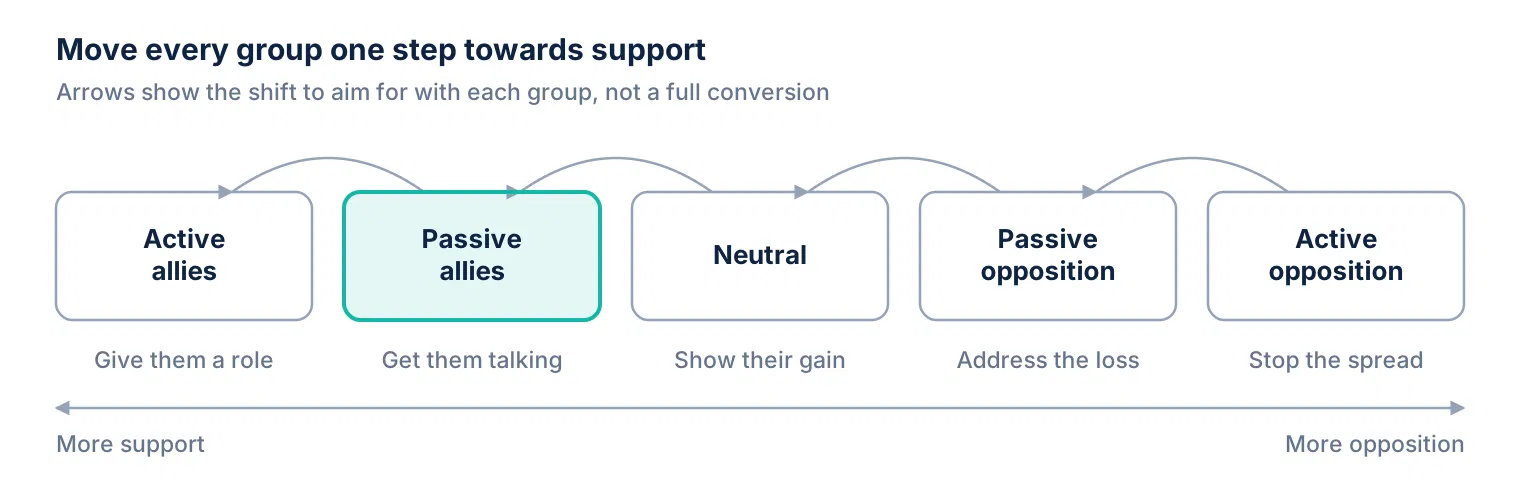
Passive allies are highlighted because they are the group most projects overlook, and the cheapest to move.
Where projects actually fail
Put the two tools together and the failure mode becomes visible. A project fails when leadership plans the change around the formal structure, while adoption is decided by the informal one. The Resistance Inventory tells you why people will push back. The Spectrum of Allies tells you who will decide whether everyone else follows.
A board-ready framework: five moves, five numbers
The framework below works at two levels. A change lead can start on step one tomorrow. A board can read the five numbers on a single slide and know whether the change is on track.
- Price the risk. Put a dollar value on the benefits that depend on people changing how they work. Use the expected-value arithmetic above. This turns change management from a cost line into risk cover.
- Map the human system. Build the Resistance Inventory and the Spectrum of Allies before design is signed off, not after go-live. Name the informal influencers, not just the department heads.
- Make sponsorship visible. A sponsor who approves the budget but never speaks about the change signals that it's optional. Agree in advance what the sponsor will say, to whom, and when.
- Measure adoption, not activity. "Training delivered" and "emails sent" measure effort. Usage, proficiency and process compliance measure whether the change is happening.
- Reinforce until it sticks. Tie the new way of working to how people are measured and recognised. Keep tracking after go-live, because that's when old habits come back.
The board slide
| Number | What it tells the board | Type |
|---|---|---|
| Benefits at risk ($) | How much of the business case depends on behaviour change | Stake |
| Readiness score by group | Whether each affected group is aware, willing and able to change | Leading |
| Spectrum position of key influencers | Whether the people others follow are moving towards support | Leading |
| Adoption rate by group | Whether people are actually using the new system or process | Lagging |
| Benefits realised vs plan ($) | Whether the change is producing the return that justified it | Lagging |
Leading numbers give the board time to act. Lagging numbers tell them whether it worked. A project reporting only lagging numbers finds out about a people problem when it's already a financial one.
From firefighting to orchestration
Most organisations already do change management. They just do it late, unfunded and under a different name: "adoption issues", "stabilisation", "phase two". That is change management as firefighting, and it is the most expensive version there is.
The alternative is to treat the people side with the same rigour as the technical side. Price the risk at the business case. Map resistance and influence before design is locked. Report leading indicators to the board alongside budget and schedule. Keep measuring until the new way of working is simply how work gets done.
The soft skills were never soft. They are where most of the project's value is won or lost, and the numbers have been saying so for years.
Start with one change you're responsible for now. Put a dollar figure on its benefits at risk, then fill in the first three rows of a Resistance Inventory. To see where your people stand today, try the free Readiness check on ChangeOS.